A strong trade journal tells you more than whether you made money. It tells you what changed, what repeated, what drifted, and what deserves a decision. AI becomes useful when it helps traders and teams reach that level of review more consistently without weakening the evidence underneath it.
Direct answer
AI trade journaling for MetaTrader works best when AI sits on top of verified trading evidence, not when it replaces that evidence. The strongest workflow uses official MetaTrader history, reports, and journals as the raw layer, then uses documented OrderHistory, TradeStats, account-state, and connection checks to build an application-side review surface. AI then helps summarize, cluster, label, and question that evidence so the trader can review faster and more honestly.
This is the key distinction: AI trade journaling is not an AI trader. It is a review workflow. Its job is to help you understand what happened, what changed, what repeated, and what deserves a decision. It should not invent trades, invent metrics, or quietly turn soft narrative into hard truth.
Why AI journaling is different from a normal dashboard
A normal dashboard answers, “What happened?” A good journal asks, “Why did it happen, what pattern does it belong to, and what should change next?” AI becomes useful when the volume of evidence grows beyond what most traders review consistently.
That problem shows up in several places:
- Single-account review. The trader has enough history and enough metrics, but not enough discipline to turn them into recurring lessons.
- Multi-account monitoring. The team can see which account is drifting, but not which repeated behaviors explain the drift.
- Signal or copy operations. Operators can see performance changes, but not the fastest explanation of what changed in style, risk, or execution behavior.
The official platform already gives a lot of evidence. MT4 testing separates Results, Graph, Report, and Journal outputs. MT5 gives orders, deals, positions, filtered history, exported reports, and platform logs. But that still leaves a gap between records and review. AI is most useful in that gap.
If the core journal structure is not in place yet, start with the trade journal dashboard guide. That article explains which metrics deserve the most attention before an AI layer is added on top.
What evidence AI should actually read
The quality of an AI journal is limited by the quality of its inputs. That means the evidence layer has to be explicit.
Official MetaTrader platform outputs
The official MT4 tester results help shows a clean review model: Results, Graph, Report, and Journal. That already tells us how MetaTrader itself thinks about review. Trade lists, curve behavior, summary statistics, and logs are different evidence types and should stay different.
The official MT5 history help says the History tab can be viewed as orders, deals, and positions, filtered by time interval, and saved as a report. The official MT5 advanced report goes further and shows summary values such as Balance, Equity, Margin, Free Margin, Closed Trade P/L, and Floating P/L. The official MT5 report definitions add metrics such as Profit Factor, Recovery Factor, Max. Drawdown, Max. Deposit Load, MFE, and MAE.
The official platform logs page matters too. Journals are not just error output. They are operational evidence. When a setup behaves differently than expected, the log layer often explains whether the issue was connection state, environment drift, migration trouble, or something else the performance curve alone cannot show.
Documented app-side workflow families
The application layer becomes useful when the evidence is no longer trapped inside manual exports. In this workspace, the first-party docs authority file records verified workflow families that matter directly for journaling:
AccountSummaryfor current account state/CheckConnectfor connection-state checks/OrderHistoryfor account UUID plus date-range history retrievalTradeStatsfor computed values such asprofitFactor,expectancy,averageTradeLength,balanceDrawdownRaw,realizedPL, andunrealizedPL
This is what makes an AI-assisted journal practical. Instead of pasting screenshots into a note, you can give the AI a normalized review packet: current state, shared time window, filtered history, summary stats, and trader notes.
| Evidence layer | What it contributes | How AI should use it | What stays non-negotiable |
|---|---|---|---|
| MT4 tester outputs | Trade list, curve, report, journal | Summarize patterns, cluster repeated mistakes, generate review prompts | The original tester outputs remain the ground truth |
| MT5 history and reports | Orders, deals, positions, report windows, account summary values | Explain what changed across periods and why the result looks different | Time windows and report definitions must stay explicit |
| Platform journals | Operational context, failures, environment clues | Condense noisy log sequences into useful operator summaries | Raw log access must still be available |
/OrderHistory | Structured history by account and date range | Build repeatable review packets instead of manual exports | Date-range integrity and account identity must be preserved |
TradeStats | Computed efficiency, drawdown, and P/L context | Highlight anomalies and compare behavior across sessions or accounts | Metrics must stay documented and traceable |
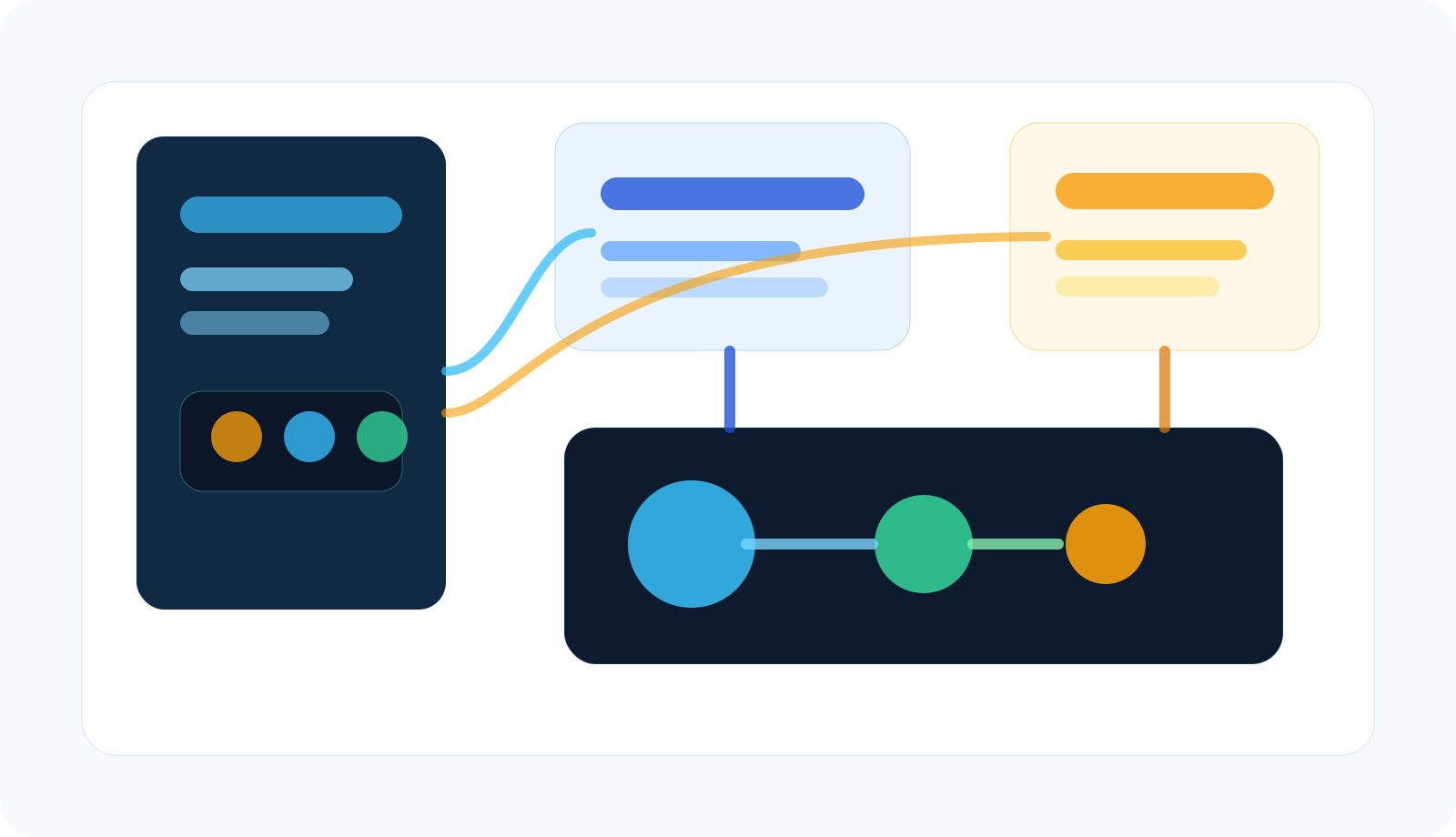
The AI layer should sit on top of verified history, reports, logs, and stats. It should not become a replacement for them.
Where AI actually helps in review workflows
AI is most useful when it converts structured evidence into faster, more disciplined review. That usually means five jobs.
1. Session summaries that preserve the important context
Most traders review badly because the friction is too high. AI can take a session packet and produce a short summary that says what changed in expectancy, drawdown, trade duration, symbol concentration, or floating exposure. That turns a vague “today felt messy” into something concrete enough to inspect.
2. Pattern labeling and mistake clustering
Traders often repeat the same mistake under different names. One day it is “gave the trade room.” Another day it is “let the loser breathe.” AI is useful when it clusters those behaviors together and proposes consistent labels across the journal. The value is not the label itself. The value is finally seeing repetition clearly enough to act on it.
3. Review questions instead of passive dashboards
A static dashboard waits to be interpreted. An AI journal can actively ask better follow-up questions:
- Why did profit factor stay stable while drawdown worsened?
- Why did trade duration double relative to the validation period?
- Why did most of the week's P/L come from one symbol or one session?
- Why is equity diverging from balance more often than before?
Those questions are where review quality improves. The AI does not need to know the final answer. It needs to help the trader ask the right next question.
4. Operator summaries for teams and provider workflows
In multi-account or provider environments, AI can condense account-level evidence into an operator note: what drifted, which accounts deserve a drilldown, which logs suggest connection or environment issues, and which accounts look healthy but different. That is especially useful when paired with multi-account performance tracking or signal-provider dashboards.
5. Decision-ready journaling prompts
The strongest journaling systems do not end with a summary. They end with a decision. AI can help produce a consistent prompt structure such as:
- What improved?
- What degraded?
- What likely caused it?
- What evidence supports that view?
- What is the next action: continue, reduce, refine, pause, or revalidate?
That is a much better use of AI than asking it whether the trader is “good” or whether the strategy is “working.”
Guardrails that keep AI journaling trustworthy
The fastest way to make an AI journal useless is to let it sound authoritative without preserving the evidence chain. Good AI journaling needs strong guardrails.
AI should propose, not certify
AI can suggest a pattern, a label, or a likely explanation. It should not certify that explanation as fact unless the supporting evidence is clearly attached. In practice, that means every useful AI summary should still link back to the raw history, report window, or journal segment it came from.
Metrics should stay documented
If the review packet includes profitFactor, expectancy, averageTradeLength, balanceDrawdownRaw, realizedPL, or unrealizedPL, the AI should use those metrics as provided. It should not improvise replacements or rename them in ways that blur meaning.
Time windows should never drift
AI summaries become misleading quickly if the packet quietly mixes today, week-to-date, and last-30-day values in one narrative. The reporting period has to be explicit, especially when the review spans several accounts or feeds a subscriber-facing workflow.
Logs and history should remain inspectable
An AI-generated sentence like “execution reliability deteriorated” is useless if the operator cannot drill into the journal or account history behind it. The raw record does not disappear because the summary is convenient.
How to design the workflow
The cleanest AI trade journaling systems follow a layered architecture.
Layer 1: collect and normalize the evidence
Pull the history, stats, and account-state data for one explicit review window. Add the relevant platform log excerpts and the trader's own notes or tags. If the workflow is cross-account, normalize the same time window and metric definitions across all accounts first.
Layer 2: build a review packet
The AI should not receive a vague pile of data. It should receive one review packet per session, strategy slice, or account cohort. That packet should state the period, the account or cohort, the main metrics, the key history excerpts, and any known trader notes.
Layer 3: generate outputs that help a human review
The highest-value outputs are usually:
- a short factual summary
- a list of anomalies or behavior changes
- suggested mistake tags or setup clusters
- three to five review questions
- a draft decision note
This is also where the system should clearly label what is factual, what is inferred, and what still needs confirmation.
Layer 4: human review and acceptance
A trader, analyst, or operator accepts, edits, or rejects the AI output. That matters because accepted tags and decisions are what make the journal better over time. Otherwise the system just produces disposable summaries.
Layer 5: feed insights back upstream
The best journaling systems loop back into validation and operations. If the review keeps finding drift in trade duration or drawdown behavior, that should feed into strategy validation. If the review keeps finding account-level anomalies, it should feed into the multi-account or provider workflow, not stay trapped in private notes.

A useful AI journal closes the loop: evidence in, structured review out, human decision made, and lessons fed back into validation or live operations.
How AI journaling fits multi-account and provider operations
AI journaling becomes more valuable as the number of accounts or stakeholders increases. In a single-account workflow, it mainly saves review time and improves consistency. In a team workflow, it becomes part of operational hygiene.
For multi-account review, AI can highlight which accounts drifted from the cohort and which differences are most likely to matter. It should not decide the ranking by itself. It should help reviewers understand why the ranking changed.
For signal-provider operations, AI can produce internal summaries for support or monitoring teams while the public dashboard stays grounded in verified performance, risk, and age. This is where the distinction in the signal-provider dashboard guide matters: public trust signals and internal review signals should not be blurred together.
For copy-trading or trader-room products, AI journaling can also generate cleaner weekly review digests, provider notes, or operator queues. But the same rule still applies: the AI layer is a helper around the control model, not a substitute for it. The closest architecture companion here is building a copy trading dashboard with MetaTrader API.
If the reader needs the broader application boundary around these workflows, the best internal handoff is how to connect AI workflows to a MetaTrader API, followed by the MetaTrader API documentation guide and What Is a MetaTrader API?.
Common mistakes
Feeding AI screenshots instead of structured evidence
Images can be useful context, but a trustworthy journal should still be built from structured history, reports, logs, and documented stats. Otherwise the AI ends up guessing too much.
Letting the narrative outrun the data
If the AI summary sounds convincing but the metrics, logs, or history behind it are unclear, the workflow is already off track.
Mixing unlike periods or stale states
This is the same silent failure that breaks dashboards and spreadsheets. AI does not fix it. It can actually hide it better if the packet is poorly assembled.
Confusing AI coaching with execution logic
A journaling workflow can help a trader reflect, but it should not quietly become the strategy engine or risk engine unless that boundary is designed and governed explicitly.
Failing to save the accepted review decision
If the system stores summaries but not final accepted decisions, the journal becomes harder to learn from over time. The accepted note is what turns review into institutional memory.
Conclusion
AI trade journaling for MetaTrader is valuable when it improves review quality without weakening evidence quality.
The official platform already gives traders and teams a serious evidence base: MT4 tester outputs, MT5 history, saved reports, advanced statement views, and platform journals. The documented first-party app layer adds structured history, stats, current account context, and connection-state checks that make those review workflows easier to operationalize.
That combination is where AI becomes genuinely useful. Not as a magic answer engine, and not as a replacement for the raw record, but as a disciplined layer that helps traders and teams summarize faster, tag more consistently, ask better questions, and make clearer decisions.
References and Source Notes
- MetaTrader 4 Strategy Tester Results - Official MT4 testing outputs for Results, Graph, Report, and Journal
- MetaTrader 5 Trading Account History - Official MT5 history views for orders, deals, positions, filtering, and report export
- MetaTrader 5 Trading Report - Official MT5 report definitions for Profit Factor, Recovery Factor, Max. Drawdown, Max. Deposit Load, MFE, and MAE
- MetaTrader 5 Advanced History Report - Official advanced report structure with Balance, Equity, Margin, Free Margin, Closed Trade P/L, and Floating P/L
- MetaTrader 5 Platform Logs - Official journal/log reference for operational review
- MetaTraderAPI.dev Authentication - First-party auth model for app-side review workflows
- MetaTraderAPI.dev MT4 Account Docs - Documents RegisterAccount, GetAccounts, AccountSummary, and AccountDetails
- MetaTraderAPI.dev MT4 Connection Docs - Documents CheckConnect for connection-state monitoring
- MetaTraderAPI.dev MT4 Order History - Documents date-scoped OrderHistory access
- MetaTraderAPI.dev MT4 Trade Stats - Documents TradeStats metrics such as profitFactor, expectancy, averageTradeLength, and drawdown values
- MetaTraderAPI.dev MT5 Order History - Documents MT5 OrderHistory coverage
- MetaTraderAPI.dev MT5 Trade Stats - Documents MT5 TradeStats coverage
- MetaTrader Trade Journal Dashboard: Which Metrics Actually Improve Performance - Related article on the base review layer
- How to Track MetaTrader Performance Across Multiple Accounts Without Spreadsheet Drift - Related article on normalized multi-account review
- How to Build a MetaTrader Performance Dashboard for Signal Providers - Related article on provider-facing trust and operations
- How to Use a Trading Simulator to Validate a MetaTrader Strategy Before Going Live - Related article on feeding review insights back into validation
- How to Connect AI Workflows to a MetaTrader API - Authority-layer article on evidence packets, structured outputs, and guarded MetaTrader AI workflows
- MetaTrader API Documentation Guide - Internal docs map for broader workflow implementation
- What Is a MetaTrader API? - Foundation article for the category
FAQs
- What is AI trade journaling for MetaTrader?
It is a review workflow that uses AI to summarize, label, and question verified MetaTrader history, reports, logs, and metrics so traders or operators can review performance more consistently.
- Can AI replace a MetaTrader trade journal dashboard?
No. A dashboard remains the structured evidence surface. AI becomes useful when it sits on top of that surface to generate summaries, anomaly labels, and review prompts without replacing the raw history or the documented metrics.
- Which inputs matter most for AI-assisted trade journaling?
The most useful inputs are date-scoped order history, documented trade stats, account-state context, platform reports, log excerpts, and the trader's own notes or tags for the same review window.
- How do you stop hallucinated conclusions in an AI journal?
Keep the reporting window explicit, preserve links back to raw history and logs, limit metrics to documented fields, label inferences clearly, and require a human to accept or edit the final review note.
- Is AI journaling only useful for single-account traders?
No. It becomes even more useful in multi-account, signal-provider, or copy-trading workflows because the AI layer can condense larger volumes of review evidence into operator-ready summaries and decision prompts.