Follower recovery is where copy-trading products either become operator-grade or start losing trust. A pause, mismatch, stop condition, or manual account change should lead to a visible recovery workflow, not a silent resume.
Direct answer
Copy-trading teams recover paused followers safely by treating recovery as a real lifecycle state, not as a silent reconnect. Once a follower account has paused, stopped copying, gone out of sync, or been manually interfered with, the product should decide explicitly whether it can re-synchronize automatically, whether it needs a manual operator review, and whether the account is even eligible to reenter the follower cohort yet.
This is the natural next layer after subscriber drift, mismatches, and exception review. That article explains how to classify divergence. This one focuses on what happens after the team has decided a follower needs recovery instead of simple classification.
Why follower recovery is its own operator phase
Recovery is not the same thing as drift detection. Drift tells you that one follower no longer matches the intended copy model. Recovery asks a different question: what should happen next so that the account can rejoin the copied cohort without creating a second incident?
- A paused follower may be healthy enough to resume, but only if its current state still matches the control model.
- An out-of-sync follower may need the product to rebuild missing copied positions or to explain why it should not.
- A manually altered follower may need a stricter reentry path because copied positions, custom positions, or sizing assumptions are no longer clean.
- A stopped follower may need a hard re-onboarding decision rather than a simple resume button.
That is why recovery belongs beside health checks and exception review, not underneath them. Follower health checks, allocation rules, and audit trails tell the system what should be true. Recovery decides whether those truths still hold after something has already gone wrong.
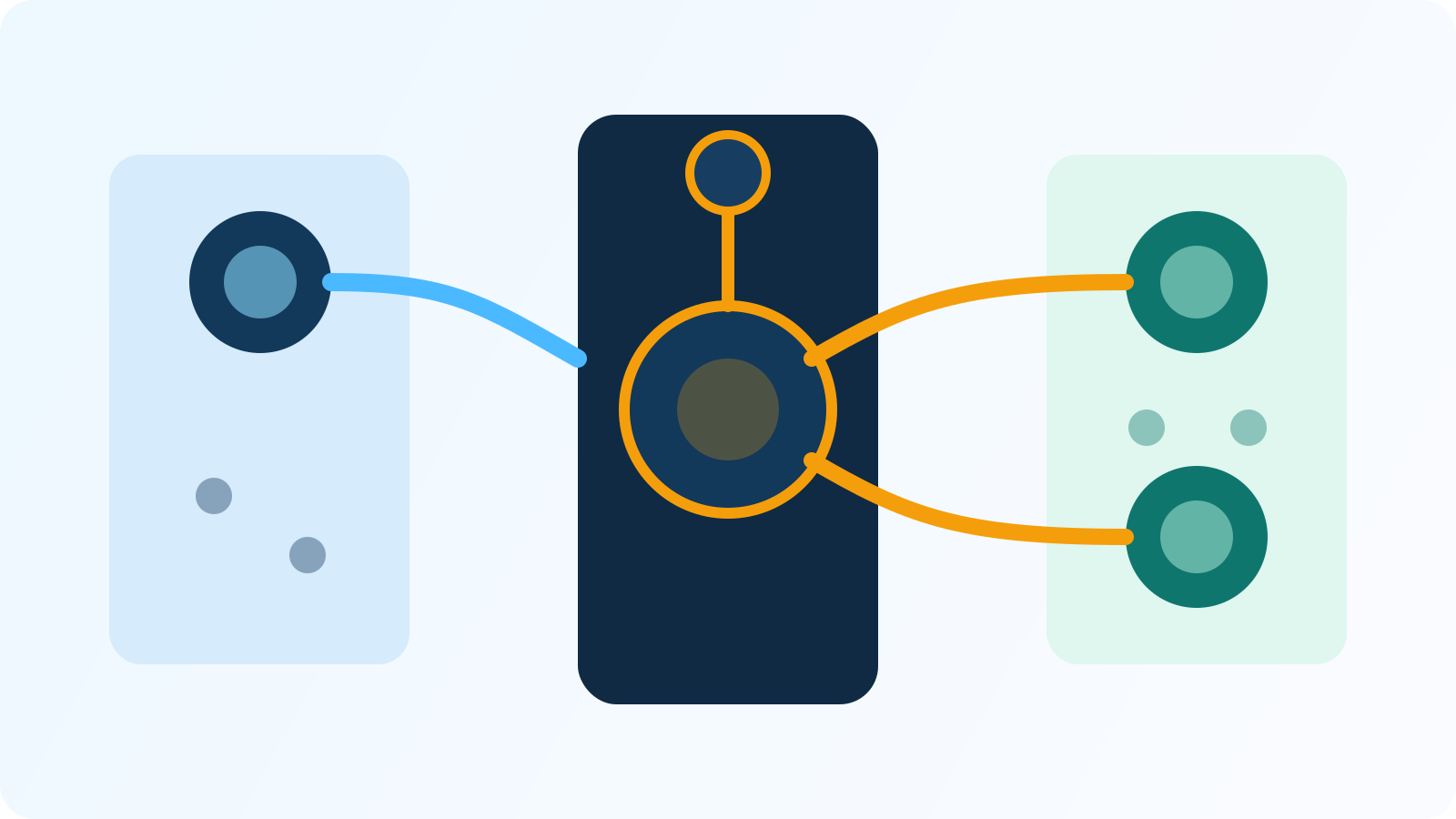
A good copy-trading product makes recovery visible as a state transition, not as a hidden side effect.
What official MetaTrader signal workflows already teach us about recovery
The official MetaTrader subscriber help is unusually valuable here because it treats copying as a monitored workflow with synchronization, re-synchronization, stop conditions, and recovery decisions that can be observed. That is exactly the mindset a custom copy-trading product should borrow.
Re-synchronization is a first-class workflow
The official subscriber help explains that synchronization happens when copying begins and that a later re-synchronization can occur while copying is already live. It describes re-synchronization after network issues, after terminal restart, after reconnecting to the trading account, and even after balance changes that materially alter the copying percentage. That tells us something important: serious copy-trading systems do not pretend a follower is always in a clean steady state.
Manual interference creates recovery consequences
The same official workflow explains that if a subscriber manually closes a copied position, the position can be opened again during re-synchronization. It also explains that custom positions or orders on the subscriber account can block or alter synchronization behavior depending on the settings. That is a powerful product lesson: manual intervention is not a harmless side note. It changes the recovery path.
Suspend, unsubscribe, and transfer are not the same thing
The official subscriber workflow distinguishes between suspending copying by disabling realtime subscription, unsubscribing completely, and moving a subscription to a different account. It also notes that unsubscribing does not close existing copied positions and that account transfer is a separate action with its own limit. For custom products, that is a reminder to separate these states clearly:
- temporary pause
- controlled resume
- full exit
- account migration or re-assignment
If the interface collapses those states into one generic “resume copying” action, the operator loses clarity exactly when clarity matters most.
Provider monitoring is part of recovery quality too
The official provider help says monitoring must be enabled and uses investor-password read-only access for data gathering. It also says the provider does not need to stay permanently connected because the server reads operations through that monitoring path. That is relevant to recovery because follower reentry quality depends on trustworthy state collection on both sides. Recovery without reliable monitoring becomes guesswork.
When a follower should enter recovery state
Not every alert deserves a full recovery workflow. But certain follower conditions should immediately move the account into a recovery state instead of letting copying continue as though nothing changed.
1. Copying stopped because of an equity or guardrail threshold
The official subscriber settings include a stop-equity threshold that terminates copying and closes copied positions when equity drops below the configured level. In a custom product, the equivalent event should open a recovery state automatically. The account should not quietly rejoin the cohort until the team knows whether the new state still matches the follower’s intended participation model.
2. The follower became unsynchronized after requotes or connectivity problems
The subscriber help explains that repeated requotes can leave provider and subscriber states unsynchronized, after which the platform later retries synchronization. That is a good model for custom products too. The operator view should make it clear whether the account is:
- temporarily waiting for the next sync attempt
- eligible for automatic re-sync
- already too far from the expected state and therefore waiting for review
3. The account was manually changed
If copied positions were closed manually, if custom positions were added, or if pending orders appeared outside the copy workflow, the system should stop pretending this follower still belongs to the clean copied set. That does not always mean permanent exclusion. It does mean the account needs a recovery path instead of blind continuation.
4. Deposit load or account balance changed materially
The official subscriber help warns against changing deposit load while copied positions are open, because open position volumes can be corrected immediately. It also explains that balance and credit operations can force synchronization when the copying percentage changes materially. That makes balance changes a real recovery trigger, not a bookkeeping footnote.
5. The follower is being moved or reassigned
The official workflow includes a subscription-transfer path for accounts with copying issues. That is helpful product guidance. When a follower account is being migrated, reassigned, or replaced, the system should treat that as a deliberate recovery or transfer workflow, not as a hidden edit to the same follower row.
How to choose between auto re-sync, manual review, and controlled reentry
The key operator question is not “can we reconnect this account?” It is “what is the safest next action for this specific recovery trigger?” A useful control model usually separates three actions:
- Automatic re-synchronization when the system has enough confidence that the follower is still within the intended control model.
- Manual operator review when the current state is ambiguous, altered, or risky.
- Controlled reentry when the account may return, but only after explicit approvals or resets.
| Recovery trigger | What to verify | Best next action |
|---|---|---|
| Short disconnection, no manual changes, clean follower state | Fresh connection check, stable account summary, no unexpected orders | Automatic re-synchronization is usually reasonable |
| Repeated requotes or lag left copied positions out of sync | Current copied state versus intended provider state, slippage context, pending sync attempts | Auto re-sync if the product can prove the gap; otherwise manual review |
| Manual close of copied positions or custom positions detected | Account details, order-history window, copied-versus-custom activity | Manual review before any reentry |
| Stop-equity or hard guardrail triggered | Current equity, realized and floating outcomes, active participation settings | Controlled reentry only after explicit approval |
| Balance/deposit change altered copying percentage materially | Updated deposit participation, position sizing assumptions, re-sync effects | Controlled reentry with clear re-sizing rules |
| Follower migrated to a different account | New account registration, connection state, clean starting conditions | Treat as transfer and re-onboarding, not just resume |
This is where the earlier operator pages connect cleanly. Drift and mismatch review explains how to classify the issue. Recovery logic decides the next state transition after that classification is finished.

Recovery becomes calmer when the operator sees one explicit loop: trigger, verify, choose action, and record the reentry decision.
What the recovery evidence packet should contain
Recovery should be evidence-first, not memory-first. This is where the verified first-party docs become useful because they define the workflow families that give the product a stable review boundary.
Start with the account roster and current state
The verified first-party account docs document RegisterAccount, GetAccounts, AccountSummary, and AccountDetails. That gives the product the follower roster and the present-tense account state needed to answer basic questions first: which account is this, what is its latest known state, and should it still belong to this copied cohort at all?
Confirm connection freshness before inferring strategy behavior
The verified connection docs document /CheckConnect. Recovery decisions should use that check early. A follower that looks stale may be out of sync because the connection is unhealthy, not because the strategy logic failed.
Build one explicit order-history window around the incident
The verified order-history docs document OrderHistory with account UUID plus explicit From and To windows. That matters because recovery without one agreed evidence window turns into storytelling. The operator should be able to inspect the period before the pause, the pause itself, and the candidate reentry point inside one named packet.
Use metrics to decide whether the follower is merely disconnected or fundamentally altered
The verified TradeStats coverage includes fields such as profitFactor, expectancy, averageTradeLength, balanceDrawdownRaw, realizedPL, and unrealizedPL. Those fields do not replace case review, but they help answer a crucial question: is this account simply recovering from one interruption, or has its behavior moved far enough that it no longer belongs in the same follower cohort without fresh approval?
If your team wants summaries on top of those evidence packets, the companion workflow is AI trade journaling for MetaTrader. The AI layer should summarize the packet, not invent the packet.
Reentry rules that prevent repeat incidents
The moment of reentry is where weak copy-trading products often create their second mistake. They fix the incident and then allow the account to rejoin in a way that recreates the same risk immediately. Good reentry rules are boring on purpose.
Separate pause from full exit
The official subscriber help makes a clean distinction between suspending realtime copying and unsubscribing fully. Your product should do the same. A paused follower is still part of the managed relationship. A fully exited follower is not.
Do not hide manual intervention
If an operator or trader closed copied positions manually, that fact should remain visible at reentry time. Reentry is safer when the system remembers why the account needed recovery in the first place.
Require explicit agreement when sizing assumptions changed
If deposit participation, leverage assumptions, or balance conditions changed during the pause, reentry should not use the old sizing rules by accident. The system should display the new participation assumptions clearly before the follower becomes active again.
Use transfer-style logic for account replacement
If the user moves to a different account, treat that as a new activation workflow with history and linking context, not as a hidden edit on the same account row. The official subscription-transfer flow is a good model because it treats account movement as its own controlled action.
Store the reentry decision and not just the raw evidence
The recovery packet should end with a stored operator disposition: auto re-synced, manually approved for reentry, held for further review, migrated to a new account, or removed from the follower set. That turns recovery into institutional memory instead of repeating the same incident every week.
Architecture for recovery and reentry
A practical recovery stack usually has four layers:
- Follower-facing and operator-facing product views: pause states, copied-trade status, recovery prompts, reentry controls
- Application logic: recovery triggers, re-sync rules, approval queues, transfer workflows, and decision logging
- Account and review boundary: account registry, account summaries, connection checks, history windows, and stats
- Underlying trading environment: provider and follower accounts under live market conditions
The clean design rule is that recovery policy belongs in the application layer. The account boundary gives you facts. Your product decides whether those facts justify automatic re-sync, operator review, or controlled reentry.
This is also why the broader cross-domain pages still help. If a reader needs the bigger category framing, point them to What Is a MetaTrader API?. If they need the docs map, use the MetaTrader API documentation guide. If the next question is how AI summaries should sit on top of these recovery packets, the authority handoff is how to connect AI workflows to a MetaTrader API. And if the team also needs a public trust surface for providers, the right companion page is a MetaTrader performance dashboard for signal providers.
Common mistakes
Treating recovery as just a reconnect
A connection can come back while the follower remains logically unsafe to reenter. Recovery needs state review, not just network recovery.
Collapsing pause, resume, unsubscribe, and transfer into one action
Those are different operator decisions with different consequences. The UI should make that obvious.
Ignoring manual account changes during copying
Manual closures, unrelated positions, or altered sizing rules create a different recovery path from a simple short disconnection.
Reviewing incidents without one explicit evidence window
If the team cannot point to one history window and one recovery packet, the discussion will drift into memory and assumptions very quickly.
Allowing silent reentry after hard stop conditions
If copying stopped because of an equity guardrail or a serious mismatch, a silent resume makes the product look careless.
Conclusion
The strongest copy-trading teams do not just detect follower problems. They make recovery and reentry explainable.
The official MetaTrader subscriber workflow already shows the shape of that system: synchronization, re-synchronization, stop conditions, suspension versus unsubscribe, and controlled transfer. The first-party account, connection, history, and stats docs give custom products a stable boundary for building the evidence packet around those decisions.
When teams separate auto re-sync from manual review, store a real reentry decision, and treat paused followers as a lifecycle state instead of an accidental reconnect, copy trading becomes easier to support, easier to audit, and much easier to trust.
References and Source Notes
- How to Subscribe to a Signal - MetaTrader 5 Help - Official subscriber workflow covering synchronization, re-synchronization, stop-equity rules, suspension versus unsubscribe, and subscription transfer
- How to Become a Signal Provider - MetaTrader 5 Help - Official provider-side setup covering monitoring enablement and investor-password read-only access
- Trading Signals and Copy Trading - MetaTrader 5 Help - Official overview of the wider signals and copied-trade reporting model
- How to Choose a Signal - MetaTrader 5 Help - Official monitoring page covering drawdown, subscriber funds, and trust surfaces
- MetaTraderAPI.dev Authentication - Official first-party auth model for Single Account and Pro plans
- MetaTraderAPI.dev MT4 Account Docs - Official account docs covering RegisterAccount, GetAccounts, AccountSummary, and AccountDetails
- MetaTraderAPI.dev MT4 Connection Docs - Official connection docs covering CheckConnect and account UUID usage
- MetaTraderAPI.dev MT4 Order History - Official OrderHistory docs documenting account UUID plus From and To windows
- MetaTraderAPI.dev MT4 Trade Stats - Official TradeStats docs documenting profitFactor, expectancy, averageTradeLength, realizedPL, unrealizedPL, and drawdown fields
- How Copy Trading Teams Handle Subscriber Drift, Mismatches, and Exception Review - Related article on classifying divergence before the recovery decision starts
- How Copy Trading Operators Use Follower Health Checks, Allocation Rules, and Audit Trails - Related article on the control model that should feed recovery and reentry decisions
- How to Build a Copy Trading Dashboard with MetaTrader API - Related architecture article for the larger product system
- How to Build a MetaTrader Performance Dashboard for Signal Providers - Related subscriber-facing trust and provider reporting article
- AI Trade Journaling for MetaTrader - Related evidence-summary workflow article
- MetaTrader API Documentation Guide - Cross-domain docs map for broader implementation context
- What Is a MetaTrader API? - Foundation article for the category
FAQs
- What should trigger follower recovery in copy trading?
Follower recovery should start when an account stops copying, becomes unsynchronized, hits a hard guardrail, is manually altered, or is moved to a new account context.
- When is automatic re-synchronization reasonable?
Automatic re-synchronization is most reasonable when the account is still healthy, the state gap is explainable, and no manual or structural changes make the copied state ambiguous.
- Should paused followers reenter immediately?
Not always. A paused follower should only reenter once the system has verified the current account state, the recovery trigger, and whether the sizing and control assumptions are still valid.
- Which MetaTrader API workflows matter most for recovery?
The most useful workflow families are account registry and summaries, connection checks, order-history windows, and trade-stats views that help operators compare the current follower state with the intended copied state.