
A prop evaluation does not just test whether your EA can make money. It tests whether the strategy, the controls, and the runtime can stay inside a public rule set long enough for the edge to matter.
Direct answer
To prepare a MetaTrader EA for a prop firm evaluation, do not stop at the backtest. You need to validate the trading logic with the official MT4 or MT5 tester, translate the firm's public rules into hard guardrails, and make sure the runtime can survive the evaluation without avoidable operational mistakes.
This is why passing a prop firm challenge with an EA is a different problem from building a profitable-looking backtest. The backtest asks whether the idea had an edge under the chosen assumptions. The evaluation asks whether the strategy, the deployment, and the trader's controls can survive a public ruleset without drifting into disallowed behavior.
Why prop evaluation is different from ordinary backtesting
A normal backtest is mostly about behavior under historical conditions. A prop evaluation adds another layer: rule compliance. Suddenly the strategy has to do two jobs at once.
- It still needs a trading edge strong enough to justify the attempt.
- It also needs rule discipline strong enough to stay inside the firm's limits while it tries to reach the target.
That changes how you should think about the EA. In a normal personal account, a messy day might be survivable if you reduce size or intervene manually. In a prop evaluation, one bad session can invalidate the whole account. That means the EA has to be prepared not only for profit generation, but for failure containment.
The stronger mental model is this: a prop evaluation is a constrained operating environment. You are not only testing whether the EA can make money. You are testing whether it can behave acceptably inside a published policy box.
If you are still in the testing stage, the most useful first step is using a trading simulator to validate a MetaTrader strategy. That page covers how to prove the basic behavior. This article starts where that one ends: once the strategy looks promising and you need to translate it into a challenge-safe workflow.
What current public evaluation rules actually look like
Public prop rules change over time and vary by firm, so you should always re-read the exact rule pages for the program you are joining. But a current public example is still useful because it shows the shape of the problem. In the Quant Funded FAQ checked on April 16, 2026, the evaluation includes a 5% max daily loss, a 10% max overall loss, a minimum of 4 trading days in each phase, and unlimited time to pass.
The same FAQ also says that positions must be closed before moving to the next stage after the target is hit, that login credentials must not be changed, and that EAs are allowed but certain categories are prohibited or restricted. Their current examples include high-frequency EAs, news-scalping EAs, latency-arbitrage styles, and some reverse-trading or overexposure behaviors. The FAQ also includes a 45% consistency score concept and funded-stage news-trading restrictions.
The lesson is not that every firm uses those exact thresholds. The lesson is that prop rules usually combine four different kinds of constraints:
- Loss limits, such as daily loss and overall drawdown
- Progress rules, such as profit targets and minimum trading days
- Behavior rules, such as prohibited EA styles, overexposure, or certain news-trading patterns
- Operational rules, such as credential handling, region/IP consistency, or closing positions before a stage transition
That mix is exactly why a backtest is not enough. A backtest may tell you whether the entries and exits made sense historically. It does not automatically tell you whether the EA will stay inside the evaluation's published guardrails.
| Rule family | What it protects | What the EA or operator should prepare |
|---|---|---|
| Daily and overall loss | Capital preservation | Hard stop conditions, session loss caps, and kill-switch logic |
| Profit target and minimum days | Stage progression quality | Pacing discipline instead of one lucky burst of risk |
| Behavior restrictions | Fair and sustainable trading behavior | Review whether the strategy resembles prohibited styles such as HFT, news scalping, latency games, or abusive account coordination |
| Operational restrictions | Monitorability and review integrity | Credential discipline, clean runtime, clear logs, and controlled deployment |
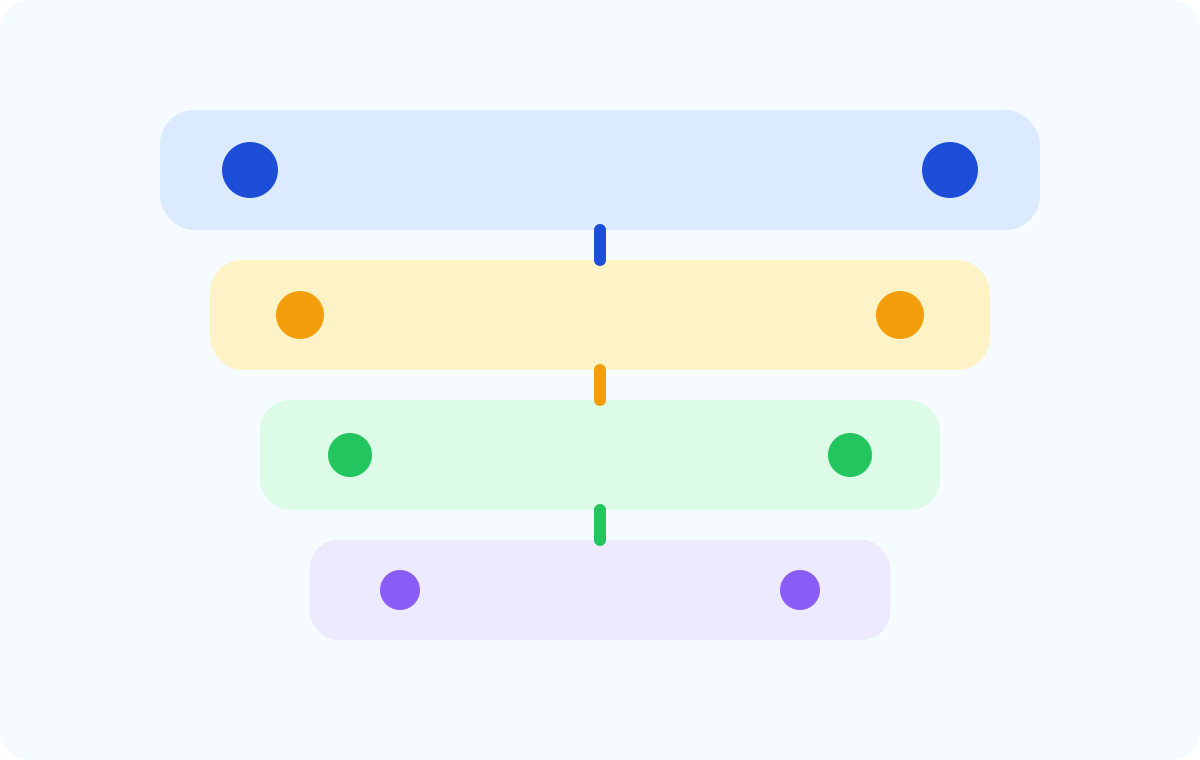
A challenge-safe EA sits inside several rule layers at once: risk, pacing, behavior, and operational discipline.
What the official MetaTrader testers help you validate
The official tester docs matter here because they tell you what the platform can already do before you introduce any prop-specific tooling. The MT4 Strategy Tester is built around historical testing, optimization, and visual mode. The MT5 strategy tester expands that workflow with richer testing controls, additional testing features, and remote-agent support. The MT5 visualization help is especially useful because it encourages traders to step through the behavior instead of trusting the final equity curve blindly.
For prop preparation, those tools answer three practical questions.
1. Does the EA behave consistently enough to deserve the attempt?
The first question is still a strategy question. Does the EA trade coherently across more than one market condition, or does it only look attractive in one flattering slice of history? If the logic is unstable before the challenge, the prop rules will not fix it.
2. Can you see the failure pattern before it becomes a breach?
This is where backtest review becomes more valuable than raw optimization. You want to inspect losing clusters, trade duration, session concentration, symbol concentration, and how the strategy behaves after a loss streak. A prop evaluation punishes uncontrolled bad sequences more harshly than an ordinary demo account does.
3. Are the review outputs good enough to support decisions?
The official MT5 report and advanced history report are useful here because they show the kind of account-level evidence you should already be reading before a challenge. The advanced report explicitly includes Balance, Equity, Closed Trade P/L, Floating P/L, Margin, and Free Margin. The report help also defines metrics such as Profit Factor and multiple drawdown views. Those are the kinds of surfaces that help you understand whether the EA is likely to brush against a daily or overall limit.
What the official tester does not do is encode the firm's policy for you. It shows behavior. You still have to decide how that behavior maps onto the evaluation rules.
If you want the deeper testing workflow before you encode rules, go back to the simulator guide. That article is still the strongest foundation for the validation layer under this one.
How to turn evaluation rules into EA guardrails
The most professional shift you can make is to stop reading the rule page as marketing copy and start reading it as a control specification. Every important rule should become one of these:
- a hard EA guardrail
- a manual operating rule
- a review trigger
Daily loss guardrail
If the firm publishes a daily loss rule, your EA should not wait for the dashboard to invalidate the account. It should have a lower internal threshold or a precise kill condition. That might mean disabling new entries after a specified intraday loss amount, flattening when equity deterioration reaches your internal ceiling, or forcing a no-trade state until the next session reset defined by the program.
The practical insight from the current Quant Funded example is that the daily limit is tied to a reset time and a combination of balance/equity behavior. That means your own prep work should include the same session boundary. If the challenge uses a midnight server-time reset, test with that reset in mind instead of using a vague calendar day in your notebook.
Overall drawdown guardrail
Overall loss rules are different because they usually represent account survival, not just one session's damage. Your EA should know the maximum allowed deterioration from the relevant baseline and stop behaving like it has infinite room to recover. This is where many otherwise good systems fail in evaluations: the strategy assumes it can dig out later, while the rules say it may never get the chance.
Pacing and minimum-day discipline
Minimum trading days sound simple, but they often expose a deeper flaw. Traders build an EA that can hit the target quickly only by taking too much concentrated risk. Then the system either fails the loss rule or creates a suspiciously uneven profit path. A healthier preparation model asks whether the EA can produce repeatable, paced behavior instead of a one-day lottery ticket.
This is also where a current public example like Quant Funded's 45% consistency score becomes useful as a warning signal even if your chosen firm does not use the same formula. If one exceptional day is doing all the work, the strategy may be too concentrated for a rule-based environment.
Behavior filters
This is the section traders often skip because it feels less mathematical. But if the public rules prohibit or restrict certain behaviors, the EA should be reviewed through that lens before deployment. If a firm's examples explicitly mention HFT, news scalping, latency arbitrage, reverse-trading behavior, or severe overexposure, ask the uncomfortable question early: does my EA resemble any of those patterns from the outside?
Sometimes the strategy itself is fine, but the implementation creates the problem. A bot that is harmless on a private account can look like prohibited behavior if it clusters too many trades into one news burst, stacks orders too aggressively, or depends on execution assumptions that only work in a favorable demo context.
Operational rules
Credential discipline, stage-transition behavior, and account monitoring are not glamorous, but they matter. If a current public FAQ says passwords must not be changed or positions must be flat before a phase move, those are not side notes. They are part of the evaluation environment. A challenge-safe EA and workflow should be designed so they do not accidentally collide with those requirements.
Deployment and monitoring before the challenge starts
Once the logic and guardrails are ready, the next failure point is runtime. A strong EA can still lose a challenge because the deployment is careless. That is why the handoff from testing to runtime needs its own checklist.
Use a stable runtime
If the EA is meant to stay active away from your desk, the runtime should be treated like infrastructure, not like an afterthought. The practical companion here is mobile MetaTrader EA hosting. That guide explains the split clearly: your phone is the control layer, while the hosted terminal or VPS is the execution layer.
This matters even more in a challenge because random PC sleep, Wi-Fi drops, reboots, or messy migrations can look like strategy problems when they are really environment problems.
Keep the first monitoring layer boring and explicit
You do not need a giant platform to start monitoring responsibly. You need a clean answer to simple questions:
- Is the account connected?
- Is the EA still in the runtime you intended?
- Has the intraday risk state changed enough that the bot should stop?
- Do the logs and review outputs still match the plan?
If your workflow extends into an app-side monitoring layer, the verified authentication docs explain the access model, and the documented CheckConnect workflow gives you a simple connection-state surface. That does not enforce the prop rules by itself. It just helps you verify that the runtime is healthy before you misread a deployment problem as a strategy problem.
Separate trader prep from firm enforcement
For the trader, this article is about preparation. For the firm, the deeper enforcement problem is broader: account state, review queues, hard breaches, and auditability. That is why the cross-domain companion on prop-firm rule enforcement around MetaTrader accounts exists. You do not need to build that whole system to prepare an EA, but it is helpful to understand how the other side of the challenge thinks.
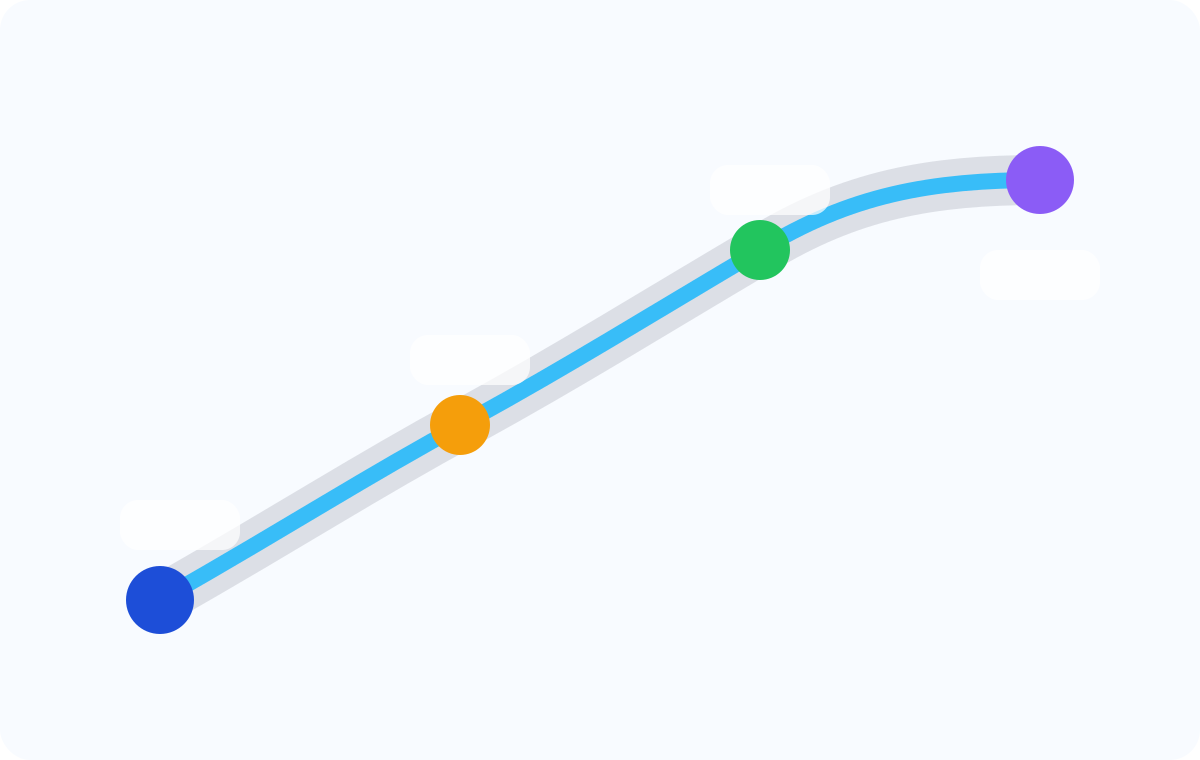
The clean path is: validate the strategy, encode the guardrails, choose a stable runtime, then monitor the evaluation instead of improvising it.
| Stage | Main question | Good enough signal | Bad sign |
|---|---|---|---|
| Backtest and replay | Does the EA behave coherently? | The logic survives several conditions and the loss pattern is explainable | The result depends on one flattering period or unexplained outliers |
| Rule translation | Do the public rules have corresponding controls? | Loss caps, behavior filters, pacing, and operator rules are explicit | The rules live only in your memory or the firm's dashboard |
| Hosted dry run | Can the runtime stay stable? | The environment, journal, and connection state look clean | The setup breaks on migration, sleep, or missing permissions |
| Evaluation launch | Can you monitor and intervene calmly? | The workflow is boring, observable, and bounded | The whole process depends on hope, screenshots, and reactive intervention |
Common mistakes
Treating a good backtest like a challenge pass
A backtest can justify the next step. It cannot certify challenge readiness by itself.
Ignoring the rule categories that are not pure math
Behavior restrictions, credential policies, stage-transition rules, and funded-stage news restrictions are still part of the environment even if they are less convenient to optimize around.
Letting the dashboard be the first line of defense
If the EA only discovers the loss limit after the firm invalidates the account, your internal controls were too weak.
Deploying a fragile runtime
Sleep mode, unstable connectivity, sloppy migrations, and missing monitoring are avoidable operational losses. In a challenge they become expensive very quickly.
Assuming one firm's example equals the whole market
Public rule pages are useful pattern references, but you still need to re-check the exact current wording for the specific evaluation you are about to trade.
Conclusion
The most reliable way to prepare a MetaTrader EA for a prop firm evaluation is to treat the challenge like a controlled operating environment, not like a slightly more exciting demo account.
The official tester docs help you validate whether the idea deserves the attempt. Public rule pages show which loss, pacing, behavior, and operational constraints the strategy must respect. A stable hosted runtime and simple monitoring layer reduce the odds that a technical mistake will turn into a trading failure.
If you do those steps in order, the EA enters the evaluation with something much more useful than optimism: a tested logic, explicit guardrails, a cleaner runtime, and a review process that can explain what happened before the rule page explains it for you.
References and Source Notes
- Quant Funded FAQ - Public evaluation FAQ checked on April 16, 2026 with examples of loss limits, minimum trading days, EA permissions and restrictions, news rules, and consistency-style requirements
- MetaTrader 4 Strategy Tester - Official MT4 overview of historical testing, optimization, and visual mode
- MetaTrader 5 Strategy Testing - Official MT5 testing help including advanced tester settings and remote agents
- MetaTrader 5 Visualization - Official MT5 visualization help for stepping through EA behavior
- MetaTrader 5 Trading Report - Official MT5 report definitions for Profit Factor, drawdown views, and related performance metrics
- MetaTrader 5 Advanced History Report - Official advanced report with Balance, Equity, Closed Trade P/L, Floating P/L, Margin, and Free Margin
- MetaTraderAPI.dev Authentication - First-party auth model for app-side monitoring workflows
- MetaTraderAPI.dev MT4 Connection Docs - Documents CheckConnect for connection-state checks
- How to Use a Trading Simulator to Validate a MetaTrader Strategy Before Going Live - Related validation article on the same domain
- Mobile MetaTrader EA Hosting - Related deployment article for hosted runtime and phone-side control
- MetaTrader Trade Journal Dashboard: Which Metrics Actually Improve Performance - Related review article for keeping evaluation feedback grounded in real outputs
- How to Build Prop Firm Rule Enforcement Around MetaTrader Accounts - Related architecture article for the firm-side enforcement layer
- MT5 API for Prop Trading Firms - Related article on broader prop infrastructure lifecycle
- MetaTrader API Documentation Guide - Docs map for the wider account, history, and connection surface
FAQs
- Can a backtest alone prove an EA is ready for a prop firm challenge?
No. A backtest can show that the strategy logic behaved a certain way on historical data, but challenge readiness also depends on rule guardrails, deployment discipline, and the ability to stay inside public evaluation rules.
- What rules should I translate into controls first?
Start with max daily loss, max overall loss, pacing or trading-day requirements, and any clearly published prohibited behaviors such as certain HFT or news-scalping styles. Those are the rules most likely to invalidate the account quickly.
- Are EAs allowed on prop firm evaluations?
Sometimes yes, but the exact answer depends on the firm and the specific program. Public rule pages may allow Expert Advisors broadly while still restricting certain behaviors or asking for additional review of third-party bots.
- Why do minimum trading days matter if the EA already reached the target?
Because many evaluations are designed to reward repeatable behavior rather than one lucky burst of concentrated risk. A system that reaches the target too quickly can still fail the broader objective if the pacing or consistency requirements are not met.
- Should I host the EA during an evaluation?
If the strategy needs continuous runtime away from your desk, a stable hosted environment is usually safer than depending on a home desktop. The important thing is to prepare the migration, runtime checks, and monitoring before the challenge starts.